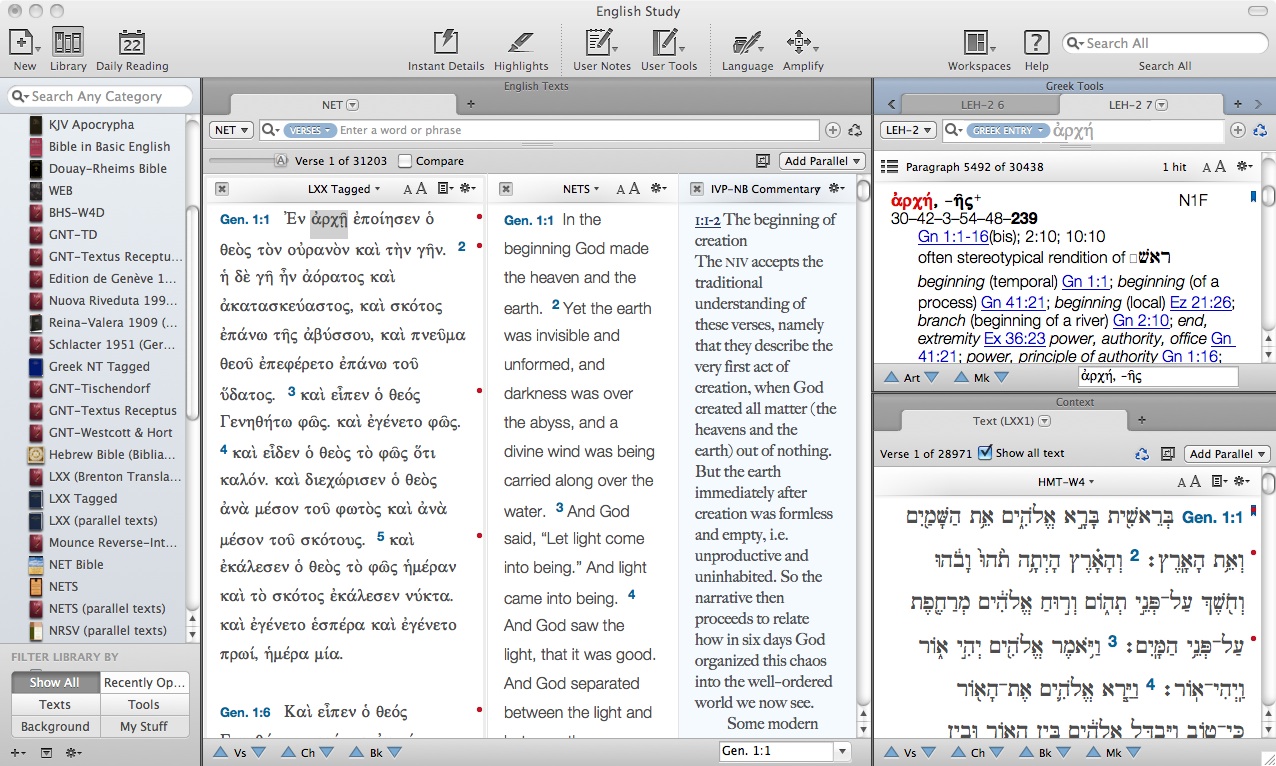
Monday, 2 January 2023

How to rename a Notebook in Logos Bible Software 10

 Here it is.  Found on a forum but too useful not to save here for future reference:

1. Select Docs.

2. Double-click to open the Notebook you want to change.

3. Secret door: Click on the gray-out Notebook icon next to the Filter icon (here I have floated the panel to make screen capture easier).

4. Now you will see the elusive three dots next to the Notebook name. It's all downhill from here...

5. Left-click on the three dots and a drop-menu appears. Select Rename.

6. Type in the new name and press Enter. And you're done.

The tab title (under the top-most red circle) may not change instantly, but it will catch up eventually.

Tuesday, 11 May 2021

How to obtain the date for the next Hebraic festival from Logos Bible Software


Logos can tell you the Gregorian date for any upcoming (major) biblical feast & festival using an interactive media tool called Israelite feast and festivals.  

Access via tools-interactive media.  Just hover your mouse pointer over the name of the event.


Thursday, 22 April 2021

What are the benefits of learning biblical Hebrew and Greek?


I came across this thread on Facebook where a Logos Bible Software user was querying the usefulness of original language study.  This response was so good, I wanted to keep it for future reference.

Q.  What are the benefits of learning biblical Hebrew and Greek?

A.

1. You are not relying upon the interpretation of others. ALL translation involves at least some interpretation. By knowing the original language, you can see and better understand the decisions made by English translators. (Just to be clear, most English translations are great and faithful to the original, but they have different philosophies of translation and always require interpretation of context.)

2. You will see additional nuance in the text. The phrase "lost in translation" exists for a reason. Sometimes you notice things in the original languages that aren't so apparent in English translations. For example, in both Hebrew and English word order can be used for emphasis within a sentence in ways that don't work in English. As another example, Greek verbs don't need an explicit "I," but there are numerous times in the Gospel of John where Jesus does use an explicit "I" when he says "I am."

3. You will understand commentaries better. Even if they're entirely in English, commentaries will still include discussions of grammar and syntax. By knowing the original languages, you can follow along MUCH better. Furthermore, most commentaries will save particularly technical discussions for footnotes where the original language is referenced.

4. You will understand English (or your own language as applicable) better. Being able to read the original languages and translate to English (or your own language) will force you to know it better. You'd be surprised how many people in Greek or Hebrew class don't know what a participle is. By learning grammar in another language, you must necessarily become at grammar in your own language. That will make you a better writer, and being a better writer will always make you a better preacher.

Look, you can still faithfully exegete the Bible without knowing Greek and Hebrew, but you will be much, MUCH better at it if you do. So I will totally steal the previous answer. What is the benefit? "Much in every way."

Source: Curtis Homan, Facebook chat, 21/4/2021.


Thursday, 4 March 2021

Auto highlighting corresponding words in another bible


With the Logos Bible Software program, sometimes I'd like to select a word in ESV and then see the corresponding word in the Hebrew/Greek Bible highlighted too. 

This can be done by configuring the visual filters feature.

Corresponding words works within a bible, so you won't see anything unless the word repeats on the visible page. If this is what you want, 

  1. Open Logos
  2. Open two bibles
  3. Lay them side by side, if not already so
  4. Click the three dots arranged as a pyramid above each bible and check the Corresponding Words and Lemma boxes.

Corresponding selection works between bibles and ESV works with AFAT, BHW 4.18, BHS/WIVU (almost any Hebrew bible, as well as Greek bibles).  If this is what you want,

  1. Open Logos
  2. Open two bibles
  3. Lay them side by side, if not already so
  4. Click the three dots arranged as a pyramid above each bible and check the Corresponding Selection box.

Tuesday, 3 November 2020

Great comparative review between Logos Bible Software and Accordance


Accordance Screenshot

Logos Bible Software and Accordance are probably the two most pre-eminent bible study programs available on the market today.

These days, all bible software applications are really publishing platforms for literature with a set of integrated tools for studying, analyzing, and preparing your own reports, sermons, and notes.

Each platform provides a means to purchase literature for study, and over time the investment can accumulate and thousands of dollars can be spent building a library of resources.  

Like buying lenses and other peripherals for a camera system, the investment can economically lock the user into the platform.

Logos Screenshot

Therefore, if the investment has yet to be made and the choice is still available as to which platform to choose, and knowing that once the investment has been made, there will eventually come a point of no return, then the importance of deciding wisely which bible software program to use is stark.

Good news:  Here is a comparative review that looks in detail at the relative merits of the two programs. The web page provides a summary of the 30-plus page full review that can be downloaded as a pdf. 

For me, I'm in too deep to Logos to change now, but if you're only just starting out, then it's not too late for you.  No regrets from me as Logos is an excellent tool and all my family use it too, and the youngest is only ten years old.

Sunday, 18 October 2020

Assisted dying: The End of Life Choice Bill: The ultimate expression of rebellion against God


Ultimately the End of Life Choice Bill is about wanting the right to decide when an individual wants to die.  

It is a demand to have this right to be the master of one's destiny even at the expense of those who are vulnerable in society to being persuaded to end their own lives.

This demand for self-determination is the same that underlies those who are pro-abortion, renaming their position as pro-choice.  

Our society has come to value an individual's right to choose or the individual's right to refuse any external norm, above all else.

In the end, if we don't care about the rights of an unborn child, then why would we care about the rights of the vulnerable who can be influenced to mistakenly end their lives?

At its heart, the demand to choose one's own path to the exclusion of all other factors, is the motivation behind the rejection of God's sovereignty over one's life.  

And to reject God's sovereignty is to reject his commandment that it is one's duty to protect the vulnerable (see Psalm 82:4; Proverbs 24:11-12; Proverbs 31:8-9; Micah 6:8).


Wednesday, 7 October 2020

In all aspects of life, even in suffering there is meaning: A powerful argument against the End of Life Choice Bill


NZ is about to hold a referendum on an assisted suicide law.  It is intended to give those afraid of suffering from a terminal illness the right to choose to have their life terminated.  

Few would argue that the suffering of Auschwitz prisoners in WW2 was not extreme.  The death rate rose sharply between Christmas 1944 and New Years Day 1945 because those who had heard that the war was nearing an end, had hoped to be freed by that Christmas.  When it didn't happen, many lost hope and gave up.

Following that ghastly period, more suffering was to come, and if it were possible, morale was to fall even further.  Yet Frankl was able to impart a message of hope.

It had been a bad day. On parade, an announcement had been made about the many actions that would, from then on, be regarded as sabotage and therefore punishable by immediate death by hanging. Among these were crimes such as cutting small strips from our old blankets (in order to improvise ankle supports) and very minor “thefts.” A few days previously a semi-starved prisoner had broken into the potato store to steal a few pounds of potatoes. The theft had been discovered and some prisoners had recognized the “burglar.” When the camp authorities heard about it they ordered that the guilty man be given up to them or the whole camp would starve for a day. Naturally, the 2,500 men preferred to fast.

On the evening of this day of fasting, we lay in our earthen huts—in a very low mood. Very little was said and every word sounded irritable. Then, to make matters even worse, the light went out. Tempers reached their lowest ebb. But our senior block warden was a wise man. He improvised a little talk about all that was on our minds at that moment. He talked about the many comrades who had died in the last few days, either of sickness or of suicide. But he also mentioned what may have been the real reason for their deaths: giving up hope. He maintained that there should be some way of preventing possible future victims from reaching this extreme state. And it was to me that the warden pointed to give this advice.

God knows I was not in the mood to give psychological explanations or to preach any sermons—to offer my comrades a kind of medical care of their souls. I was cold and hungry, irritable and tired, but I had to make the effort and use this unique opportunity. Encouragement was now more necessary than ever.

So I began by mentioning the most trivial of comforts first. I said that even in this Europe in the sixth winter of the Second World War, our situation was not the most terrible we could think of. I said that each of us had to ask himself what irreplaceable losses he had suffered up to then. I speculated that for most of them these losses had really been few. Whoever was still alive had a reason for hope. Health, family, happiness, professional abilities, fortune, position in society —all these were things that could be achieved again or restored. After all, we still had all our bones intact. Whatever we had gone through could still be an asset to us in the future. And I quoted from Nietzsche: “Was mich nicht umbringt, macht mich stärker.” (That which does not kill me, makes me stronger.)

Then I spoke about the future. I said that to the impartial the future must seem hopeless. I agreed that each of us could guess for himself how small were his chances of survival. I told them that although there was still no typhus epidemic in the camp, I estimated my own chances at about one in twenty. But I also told them that, in spite of this, I had no intention of losing hope and giving up. For no man knew what the future would bring, much less the next hour. Even if we could not expect any sensational military events in the next few days, who knew better than we, with our experience of camps, how great chances sometimes opened up, quite suddenly, at least for the individual. For instance, one might be attached unexpectedly to a special group with exceptionally good working conditions—for this was the kind of thing which constituted the “luck” of the prisoner.

But I did not only talk of the future and the veil which was drawn over it. I also mentioned the past; all its joys, and how its light shone even in the present darkness. Again I quoted a poet—to avoid sounding like a preacher myself—who had written, “Was Du erlebst, kann keine Macht der Welt Dir rauben.” (What you have experienced, no power on earth can take from you.) Not only our experiences, but all we have done, whatever great thoughts we may have had, and all we have suffered, all this is not lost, though it is past; we have brought it into being. Having been is also a kind of being, and perhaps the surest kind.

Then I spoke of the many opportunities of giving life a meaning. I told my comrades (who lay motionless, although occasionally a sigh could be heard) that human life, under any circumstances, never ceases to have a meaning and that this infinite meaning of life includes suffering and dying, privation and death. I asked the poor creatures who listened to me attentively in the darkness of the hut to face up to the seriousness of our position. They must not lose hope but should keep their courage in the certainty that the hopelessness of our struggle did not detract from its dignity and its meaning. I said that someone looks down on each of us in difficult hours—a friend, a wife, somebody alive or dead, or a God—and he would not expect us to disappoint him. He would hope to find us suffering proudly—not miserably—knowing how to die.

And finally, I spoke of our sacrifice, which had meaning in every case. It was in the nature of this sacrifice that it should appear to be pointless in the normal world, the world of material success. But in reality, our sacrifice did have a meaning. Those of us who had any religious faith, I said frankly, could understand without difficulty. I told them of a comrade who on his arrival in the camp had tried to make a pact with Heaven that his suffering and death should save the human being he loved from a painful end. For this man, suffering and death were meaningful; his was a sacrifice of the deepest significance. He did not want to die for nothing. None of us wanted that.

The purpose of my words was to find a full meaning in our life, then and there, in that hut and in that practically hopeless situation. I saw that my efforts had been successful. When the electric bulb flared up again, I saw the miserable figures of my friends limping toward me to thank me with tears in their eyes. But I have to confess here that only too rarely had I the inner strength to make contact with my companions in suffering and that I must have missed many opportunities for doing so.

Frankl, V (2006).  Man's Search for Meaning. Beacon Press.